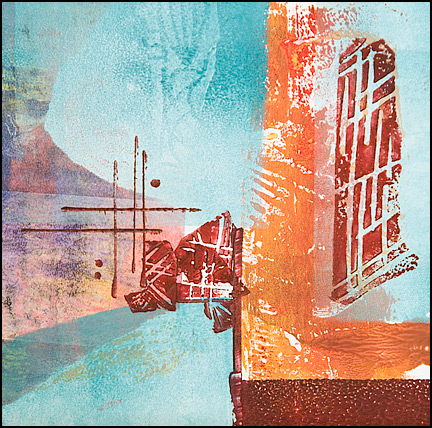
“The orgiastic moment is the laying on of the color.”
– Kurt Vonnegut (he says he hung out with a lot of painters…)
I’ve begun reading a new book, “Color Codes” by Charles A. Riley II. The subtitle is “Modern Theories of Color in Philosophy, Painting and Architecture, Literature, Music, and Psychology” – whew! Quite a range of topics to cover. So I’m sure this will generate a few postings in the near future…
One thing that has struck me already is the importance color has had in intellectual thought over time. For example, it turns out that many important philosophers spent a lot of time investigating color. I believe this is due to the fact that color is such a common phenomenon (everyone knows what red is … or do they?) so it provides a rich opportunity to explore a wide range of issues related to how we experience and understand the world around us.
Many books have been written on the subject of color – there was Kant’s Critique of Aesthetic Judgement (1790), Goethe’s Theory of Colors (1801-1810), Hegel’s Aesthetics, Schopenhauer’s Theoria colorum physiologica, and Wittgenstein’s Remarks on Color (1950). That’s a lot of brain power aimed at understanding color (and other items related to aesthetics). In particular, I am impressed that Wittgenstein spent his last days working on the issue of color – he gave it that much priority.
Just to start the ball rolling, here is an interesting question to contemplate – one which as artists we face on a daily basis. Wittgenstein talks about the difficulty of matching or comparing colors since they are so dependent on their surroundings. He asks you to consider a painting cut up into small pieces, so small that each one is essentially a single color. Like pieces of a jigsaw puzzle it is only when they are put together that they become the sky, or the vase or the figure. So, he asks, do the individual pieces show us the real colors of the parts of the picture? They do make up, by definition, the color elements in the painting, but we only see the real colors in the context of the entire painting.
At a practical level, as painters we all understand that colors take on different qualities in the context of other colors. We use that knowledge intentionally as we paint. But it certainly makes the effective management of color more complex. Take the number of colors we might create and then multiply exponentially to account for the subtle differences created by surrounding colors – it’s a dizzying palette!
I have a feeling that color is a somewhat slippery thing. Maybe that’s why we artists are so fascinated by it!


 Study Journal:
Leave a comment